
-
Yearling Weight EPD – What you need to know.
Did you know yearling weight is one of those phenotypes that tends to fall off when it comes to reporting? Seedstock breeders do a great job getting birth and weaning information submitted, and then life sometimes gets busy. For the majority of operations, they are in the midst of calving when those yearling heifers need to get weighed. Bulls sold for breeding stock do tend to get weighed because that information is expected for the sale catalog, while heifers can be much easier to overlook unless weighing them is intentionally planned out and on the calendar.
Now that you have that context, instead of solely focusing on YW EPD, we’re going to talk about what we’re leaving on the table at the seedstock level by not reporting yearling weight, and as a commercial breeder, what’s important for you to know here.
So…why does yearling weight matter when we already have a weaning weight? What happens between those two weights gives the genetic evaluation information about the post-weaning growth.
Let’s dig into Yearling Weight and Post-Weaning Gain, shall we?
As defined by American Angus Association a YW EPD: expressed in pounds, is a predictor of a sire’s ability to transmit yearling growth to his progeny compared to that of other sires.
As defined by American Simmental Association Post-Weaning Gain: genetic differences in growth after weaning.
The following is sourced from the Beef Improvement Federation (BIF): YW EPD is a reflection of both pre-weaning and post-weaning growth for that animal. The greater the yearling weight EPD, the more growth potential that animal has to pass to its offspring. Yearling weight is also sometimes used as an indicator trait for other EPDs such as Mature Weight.
Yearling weight windows vary by association, most notably, Angus at 320-440 days of age and Simmental at 330-440 for your planning purposes.
Seedstock breeders…the message for you don’t quit weighing after weaning, especially the females! Make sure to account for contemporary groups, i.e., if from weaning to yearling if they were developed differently, indicate that by assigning a group number. That yearling weight also provides the evaluation with another benchmark. We knew where that calf was around weaning, now we’re learning what happened during the post-weaning period as well. If we only capture the standouts, we’ve taken away much of the information the evaluation needs to identify genetic differences within the group for this time period, especially as it relates back to comparing sires.
Now, skip ahead, read the commercial section and then come back here. This is exactly why I’ve been harping on seedstock clients to collect mature cow weights and BCS. We know growth and mature size are related. If we collect the actual mature phenotypes, we’re giving the evaluation more information to help better identify cattle that bend that relationship (hence the term curve-bender). Having the actual mature cow weight records helps us identify the cattle that deviate from the “expected” relationship.
Side note: If you weigh your cows, do it within 45 days of weaning and collect a BCS at the same time. This information provides the evaluation with additional context around that cow’s weight and condition.
Commercial cow/calf operators…this section is tailored for you.
Post-weaning growth doesn’t exist in a vacuum. ASA reports a strong positive relationship between YW and MW EPD. In other words, cattle genetically inclined toward more yearling growth also tend (on average) to become heavier mature cattle. Key words there being “on average”, right? The relationship isn’t perfect, nothing is, but there is a strong correlation there. If we’re selecting bred heifers and there isn’t a MW prediction available, WW and YW can still give us some information about where mature size may be headed because of those genetic relationships. This is where your specific breeding objectives matter. If you’re retaining ownership through the rail, YW and PWG become increasingly important. If you’re building replacements, we also need to consider what pushing growth may ultimately mean for the females we’re creating.
 Key take aways:
 For seedstock producers, turn in yearling weight data. Your association will thank you, but most of all it provides the evaluation with more information about post-weaning growth and ultimately strengthens the genetic predictions available to your customers.
 Collecting the phenotype information on an animal is always encouraged if you can. An actual record from that animal and its contemporary group gives the evaluation insight into how those genetics performed in a similar environment and strengthens the information represented in the population from your herd, yes, even if a genomic profile is on file for the individuals.
 Commercial producers, we usually don’t get to have our cake and eat it too. Growth and mature size are genetically related, so if we keep pushing growth without monitoring the rest of the genetics package, other pieces tend to move with it. That’s where finding your sweet spot matters. In our own maternal herd, we’re not chasing maximum growth. We want enough growth while also ensuring we’re retaining the maternal components needed to build a moderate frame female which best fits our environment and available resources. In our Terminal herd? Totally different job description for those big bad boy bulls. There we’re running a moderate female while selecting bulls for top percentiles in growth along with carcass merit ($TI or $B/$W/$F indexes anyone?) because those calves are being designed specifically to perform well in the feedlot and on the grid.
Breeding with purpose and intention.
 Same EPDs Different objectives Selecting for optimums
Disclaimer: I’m not a geneticist. The information above is compiled from breed association resources and translated into practical terms based on my understanding and application of these tools.
-
Weaning Weight EPD – Explained

Banging the gavel… “Look at this adjusted weaning weight boys…he’s a whopper!”
Okay, but what are you as the bull buyer actually taking home in the genetic package?
Let’s dive into a Weaning Weight (WW) EPD.
Angus defines WW EPD as “expressed in pounds, is a predictor of a sire’s ability to transmit weaning growth to his progeny compared to that of other sires.”
ASA/IGS keeps it pretty simple: “Reported as the difference in pounds of progeny weaning weight. Higher values are more favorable.”
So let’s boil that down.
WW EPD is predicting differences in the direct genetic potential for growth -> weaning that an animal is expected to transmit to its offspring.
Let’s say we’re comparing two bulls:
Bull A = +90 WW
Bull B = +70 WWThat’s a 20-pound difference. If those bulls are mated to females within a group, we’d expect Bull A’s calves to average approximately 20 pounds heavier at weaning than Bull B’s calves. This is not saying that every calf sired by Bull A will outweigh every calf by Bull B by 20 pounds, but on the average for a group, this would be the predicted difference.
So why can’t I just look at the bull’s actual or adjusted WW?
Adjusted WW helps us make a fairer comparison of the phenotype that was measured. WW EPD is trying to predict the direct genetic difference and provide more insight into what that animal is expected to pass along to offspring.Seedstock producers…here’s where our reporting matters again (starting to see a theme?!)
Get the calves across the scale at some point between 160 and 250 days of age (according to BIF guidelines), ideally with the contemporary group weighed on the same day. A weaning contemporary group should represent calves of similar age and that have had an equal opportunity to perform: same management, location, feed/pasture, etc. If calves have been managed differently, they need to be denoted appropriately.
Remember our saying…when in doubt, split it out or at least raise the question to someone who likes to nerd out on this type of information, explain the situation and listen to their advice.
Lastly, weigh AND report the whole group. The 850-pound calf right off the cow is impressive, but his performance becomes much more informative when we know what his group mates (contemporaries) did under the same opportunity.
Commercial producers…if you sell calves at weaning, pounds obviously matter. More pounds getting loaded on a truck can be a good thing (depending on the slide). That’s one reason WW deserves a place in the selection conversation. BUT…here’s where I’m going to sound like a broken record: The goal isn’t automatically selecting for extreme. It’s finding your optimum. Selection for growth needs to be a consideration, but if you’re retaining replacements, we also need to think about the cow we’re building behind those pounds too. Mature cow size, nutrient requirements, maternal production, fertility and whether that female fits the environment she’s going to be expected to work in. That’s why I like using percentile rank to establish a range that fits our breeding objective rather than simply chasing the biggest weaning weight numbers in the catalog.
Key Takeaways:
Don’t get so blown out of the bleachers by the weaning weight printed in the catalog that you forget to ask what you’re actually buying and bringing home, the genetic potential matters.
Actual WW tells us what hit the scale. Adjusted WW helps put that phenotype on a more even playing field. And the WW EPD helps predict the direct genetic difference in weaning growth an animal is expected to pass along to its offspring. Use all the information available and find the WW percentile range that fits your marketing endpoint, honors your cow herd expectations and makes the most sense based upon available resources.
Do you remember our MILK discussion? WW is the calf’s direct genetic potential for growth to weaning. MILK is the maternal contribution to pre-weaning growth expressed through the daughters’ calves. Related pieces of the weaning weight puzzle, but they aren’t predicting the same thing and shouldn’t be used interchangeably.Disclaimer: I’m not a geneticist. The information above is compiled from breed association resources and translated into practical terms based on my understanding and application of these tools.
-
Finding the Genetic Potential in Your Herd with Genomic Testing

Have you ever wondered if you’re truly choosing the right genetics for peak performance out of your herd?
In this episode of Next Year Country, the crew visits with Leoma Donsbach, rancher and owner of Data Genie LLC. Leoma dives in to the true value of genomic testing, choosing the right replacement females, and the right bulls for your herd, along with how to properly use the data to better your operation.
We’ll also discuss the recent Cattle on Feed report, visit the wheat markets as fall planting gets underway, hear the broadcasters speculate on total harvested acres for wheat and barley, and of course a good dose of NFL happenings!
It’s all right here on Next Year Country.
Take a listen, genomics conversation starts at minute 12 https://omny.fm/shows/next-year-country/finding-the-genetic-potential-in-your-herd-with-genomic-testing
-
Calving Ease EPD – What does it tell us and what is the use case scenario?
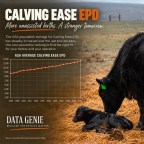
We just finished talking about Birth Weight EPD, so Calving Ease (CE) seems like the perfect one to tackle next.
According to ASA/IGS, Calving Ease Direct (CED) is reported as the difference in probability of calves being born unassisted out of first-calf heifers. Higher values are more favorable.
Angus defines Calving Ease Direct similarly: it is expressed as a difference in percentage of unassisted births and predicts the average difference in ease with which a sire’s calves will be born when he is bred to first-calf heifers.
Now, let’s boil that down.
If you’re looking for a bull to use on first-calf heifers, CE is designed to help answer a pretty practical question: Which bull is more likely to sire calves that are born unassisted?
Remember our birth weight discussion? BW EPD predicts differences in pounds of birth weight. CE predicts differences in the probability of an unassisted birth.
Birth weight certainly can play a role in calving difficulty, but it isn’t the outcome itself. That’s why if the goal is specifically to reduce calving difficulty in heifers, CE gets us closer to the question we’re typically trying to answer…what bull is most likely to be safest to use on my heifers?
So…how do we compare bulls using CE?
Let’s say we’re comparing two bulls within the same breed:
Sire A = +17 CE
Sire B = +12 CE
There’s a 5-point difference between them.
If comparably mated to first-calf heifers, Sire A would be expected to sire 5 percentage points more unassisted births than Sire B, on average.
Another way to think about it: if each bull were bred to 100 comparable heifers, we’d expect approximately five more unassisted births from Sire A’s group than Sire B’s group. Remember, though, this is a prediction across a group of calves. It doesn’t mean every calf by the +17 bull will come unassisted, or that every calf by the +12 bull will require help. Remember, the sire isn’t the only piece of the equation here either…the dam’s genetics and other factors (environment) matter too!
Now let’s introduce a new concept which we employ on our operation with regards to CE: percentile rank.
If I’m shopping for a heifer bull, I’m going to establish a CE percentile range I’m comfortable with rather than memorizing one magic EPD number. Why, you ask? Because genetic evaluations change. ASA/IGS recently underwent a CE evaluation update where individual EPD values changed, but most cattle maintained relatively similar % rankings. If I’m not aware of that change and continue selecting bulls based on an old EPD number I’ve always considered “safe,” I could inadvertently be using old criteria on new numbers. That’s why knowing where you’re comfortable at within a population, that sweet spot for % rank can be really helpful.
It’s also important to understand how the breed displays percentile ranks and which direction is considered favorable for each trait. Always check the specific breed Association’s current percentile table and know which direction you’re selecting.
Alright, Seedstock producers it’s your time to shine…this is where our phenotype reporting matters.
This is another reason complete reporting matters. The evaluation becomes more informative when we’re accurately reporting what happened across the entire calf crop, especially first-calf heifers regarding CE. Unassisted vs assisted births. Easy vs hard pulls. Those records help give the evaluation the phenotype information needed to better identify genetic differences in CE.
So…what does this mean to the commercial producer looking for a heifer bull at the sale?
Use CE as a criterion, not your entire breeding objective. If the outcome you’re trying to influence is calving difficulty in heifers, CE is the more direct tool for answering that question. Find the percentile range that fits your comfort level, enough calving ease for your risk tolerance, heifers and management system, then select for the rest of the genetic package you need.
Key Take Aways
BW EPD = expected differences in pounds of birth weight.
CE EPD = expected differences in the probability of unassisted births from first-calf heifers.
*disclaimer, I’m not a geneticist. The information above is compiled from breed association resources and translated into practical terms based on my understanding and application of these tools. -
Birth Weight EPD… and why actual BW doesn’t necessarily tell you the whole story
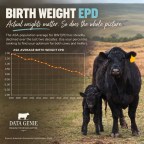
*disclaimer, I am not a geneticist so the following breakdown is based upon experience and research of this EPD. For breed or herd specific questions please visit with your Association.
As producers across the country prepare to invest in their next set of herd bulls, here’s another EPD worth discussing. According to the Beef Magazine Cowherd Genetics Survey, 78% of commercial bull buyers report requiring or using actual BW when selecting bulls. I want it noted, actual BW is useful information, but in true Data Genie fashion, let’s go a step deeper into why we should also be learning about the BW EPD, rather than simply relying on the actual weight of that individual bull when he was born to make an investment decision.
First, a note from a few Associations on the BW EPD:
Angus defines BW EPD as: “expressed in pounds, is a predictor of a sire’s ability to transmit birth weight to his progeny compared to that of other sires.”
ASA/IGS defines it as: “Reported as the difference in pounds of calf birth weight. Desirable values are dependent upon management goals, however if selecting for reduced calving difficulty the appropriate EPD to use is CE.”
Here’s the distinction we want to host a conversation around:
An actual BW tells us = what the individual animal weighed when they were born
BW EPD tells us = the expected difference in birth weight between the calves of one bull compared to the calves of another bull, on average.
Let’s say we’re looking at two bulls in a sale catalog:
Bull A had a 92 lb actual BW
Bull B had a 78 lb actual BW
Which bull is predicted to sire lighter calves? The answer is, we don’t have enough information yet. What if Bull A was born to a mature cow in a contemporary group where calves averaged around 95 lb, while Bull B was born to a first-calf heifer group in a contemporary group that averaged around 72 lb. Now those individual birth weights have a little different context…don’t they?
 Remember…an actual BW is a measured phenotype. It’s the result we observed on one animal and is influenced by both genetics and the environment/circumstances surrounding that individual calf.
 The BW EPD is a genetic prediction. It takes the reported phenotype and puts it into context with additional information available through the genetic evaluation to help predict the genetic differences that individual animal has the ability to pass along to his offspring.
So…why does this matter to seedstock producers?
This is why reporting complete and accurate birth weights across the entire contemporary group is VERY important. A 90 lb calf may sound heavy to some when viewed by itself in isolation. But what if 90 lb is actually average or even on the lighter side within that contemporary group? Now that tells us something that the individual number does not.
By reporting the whole group, we’re giving the evaluation the opportunity to compare calves that had an equal opportunity to perform and better identify the genetic differences represented within that group. Maybe calves by Sire A averaged three pounds heavier than calves by Sire B when raised under similar conditions. That information, along with pedigree/relationship information, age-of-dam adjustments, genomic information (when available), and information coming from related animals and progeny, all contributes to the published BW EPD you see.
So…what does this mean to the commercial producer walking the pens at the bull sale?
Don’t throw out the actual BW. Just don’t let it be the sole decision maker or reason you take that bull home.
That 75 lb birth weight tells you what that bull weighed on the day he was born, under the circumstances in which he was raised. It doesn’t give you the full picture. It doesn’t tell you how the same sire’s other calves weighed. It doesn’t account for all the additional related animal, progeny and genomic information available to the evaluation. It would take you hours and access to data you don’t have to put the entire picture together. And let’s not even go into ET calves…
Takeaway: We leave valuable information on the table when we don’t compare potential sires using their BW EPDs. One more thing to note: if the question you actually need to know is “Which bull is more likely to sire calves born unassisted out of my heifers?” Then don’t stop at the BW EPD. Slide over to the Calving Ease Direct (CE) EPD. BW is associated with calving difficulty, but it IS NOT the same trait. If you’re selecting a bull to reduce calving difficulty, CE is of paramount importance.So take this on your bull sale roadtrip:
Actual BW tells us what happened
BW EPD helps predict what he’ll pass along to offspring
CE helps predict the likelihood his calves will be born unassisted when mated to first-calf heifers
 BW and CE are different pieces of information answering different questions. The more of those pieces we use, the better informed our selection decisions can be. If you have questions, comments or you’re enjoying these, drop us a note to let us know below.
 -
What does the MILK EPD actually measure?
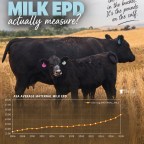
I hear about this one at a lot of bull sales and I find MILK is a fascinating EPD since it’s not necessarily measuring what the name would lead you to believe. So, in true Data Genie fashion, let’s dive into it.
MILK doesn’t measure the milk in the bucket (maybe it does in dairy but not in beef
 ). It’s expressed through pounds on the calf. More specifically, it is predicting the maternal contribution to pre-weaning growth.
ASA defines it as “the difference in maternal pounds of weaning weight from an individual’s daughters due to milk.”
Angus defines it as “a predictor of a sire’s genetic merit for milk and mothering ability as expressed in his daughters compared to daughters of other sires. In other words, it is that part of a calf’s weaning weight attributed to milk and mothering ability.”
So…how does this impact us?
On the seedstock side, think about the phenotype that we’re actually collecting and submitting here that contributes to the EPD. We aren’t putting these beef cows in a milk parlor and measuring pounds of milk or trying to milk them out in an open field. We’re weighing the calves they raise and using those records, contemporary groups and relationships within the genetic evaluation to help separate the calf’s direct genetic potential for growth from the maternal contribution of the dam.
This makes it imperative for seedstock breeders to submit complete and accurate weaning weights on calves in properly defined contemporary groups and maintain accurate dam/progeny records. Remember our contemporary group saying, “when in doubt, split it out” since contemporary groups are what help the evaluation account for environmental and management differences. At it’s most basic definition, animals that have an equal opportunity to perform.
On the commercial side, what does MILK mean to a producer buying bulls to keep replacement heifers out of?!
The goal isn’t maximum MILK. It’s selecting for an appropriate level of maternal production for your resources. Finding the percentile range that aligns best with your environment, input/forage resources and management is where you’ll find your optimum. Sometimes we’re outkicking our coverage by continually selecting for more production than our environment can economically support.
Milk requires nutrients. Mature size requires nutrients. Growth requires nutrients.
If our inputs can’t support the production we’ve selected for, maintaining females in the condition needed for reproductive performance becomes increasingly challenging and can be an uphill battle.
Penny for your thoughts…how much maternal production can your environment economically support? As you look at those MILK EPDs, take a look at Mature Weight (MW) and Cow Energy Requirement (CER) in ASA or Cow Energy Value ($EN) in Angus. Think about the ideal female you’re trying to build to best fit your environment and then use the EPD and genomic tools available to assist you with hitting that target more consistently on average.
*disclaimer, I’m not a geneticist. The information above is compiled from breed association resources and translated into practical terms based on my understanding and application of these tools.
-
What is the Stayability EPD and how is it measured?
This is intended to help understand the ASA/IGS Stayability EPD and disclaimer, I’m not a geneticist. The information below is compiled from breed association resources and translated into practical terms based on my understanding and application of these tools.
I recently created a video about the Stayability (STAY) EPD, and I think it’s worth spending a little more time talking about what this EPD is and what it isn’t. I see a number of folks point out that they have 10+ year-old females in their herd, yet some of those females or animals within those cow families have STAY EPDs in the bottom percentiles. In my opinion, some of the confusion comes from discussing STAY as though it is a measure of longevity and that’s not quite accurate or what it’s intended to measure.
Stayability predicts differences in the probability that a sire’s daughters will remain productive through six years of age, given that they first calved at two years of age. This last part is important, especially for seedstock producers and reporting. For a female to enter the Stayability evaluation, she MUST have a calf reported at age two. From there, the evaluation follows whether she continues to produce a calf each year until age 6. This information comes together within the evaluation to help better predict genetic differences in Stayability among sires.
 Why six? As a cow/calf operator, we’re over here saying, “heck, we want her to produce until well after 10 if she’s able.” Absolutely! But, there is a reason why most evaluations choose age 6. Research has suggested that it’s at about six years of age at which a commercial female that has produced a calf each year has recovered her development costs. So if you noticed, the question posed isn’t intended to answer, “Which bull will likely give me the most 15-year-old cows?” The question is closer to: Which sire is more likely to produce daughters that remain productive long enough to pay for their development? Think about those conversations we have about the cost of an open coming 3-year-old. We invested in developing her, bred her, got one calf, and then she came up open before ever having the opportunity to pay for herself. Those ones hurt. That’s the economic driver behind STAY and helps us make better selection decisions at the commercial level when choosing replacements.
There is an important limitation worth understanding, too. STAY is evaluating a specifically defined subset of females. Ones that have a calf reported at age two and then every year after within the evaluation. A female without a calf reported at two isn’t automatically a longevity failure. She may never have entered this particular evaluation. Also, if there’s a gap on a female from age 3-6 (no calf reported) that is impacting Stayability calculations. This is why it’s important to report a calf every year and give the female credit, it counts toward her cow card and filters back to the sires STAY numbers.
These are all reasons why I think understanding the definition behind any particular EPD is every bit as important as looking at and analyzing the number. STAY gives us a tool to compare sire’s with regards to daughters remaining until age 6. Anything after that should be gravy. STAY doesn’t tell us everything there is to know about fertility, longevity or lifetime productivity. It’s not meant to. The value comes from understanding exactly what we’re measuring, collecting as much complete and unbiased data as we can, and then using the appropriate tools to make more informed selection decisions that ultimately help increase profitability at the commercial level.
-
American Simmental Association is building the next $API & $TI – What do you need to know?

One of the biggest changes is that breed composition matters…
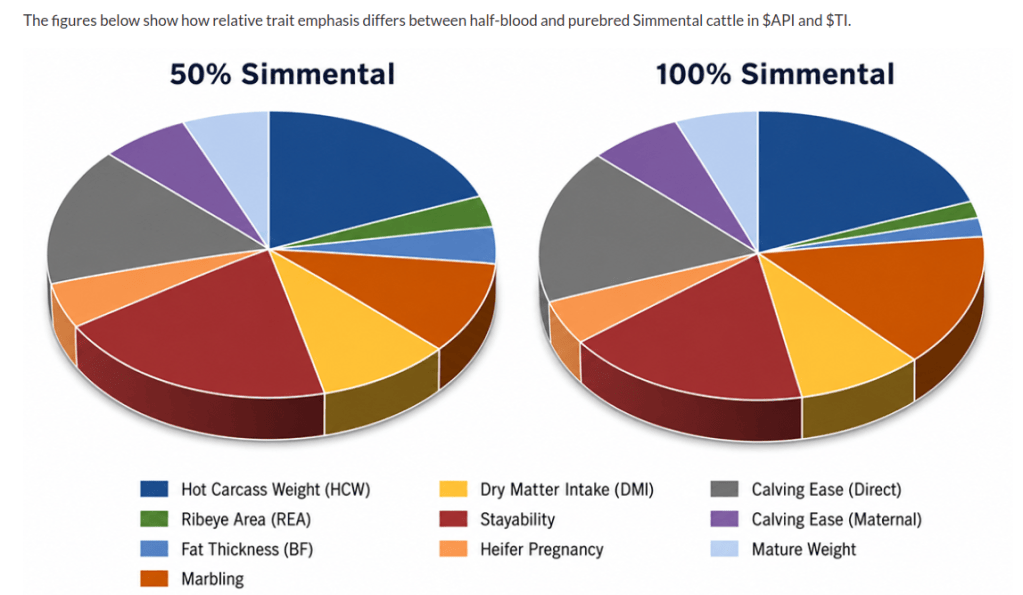
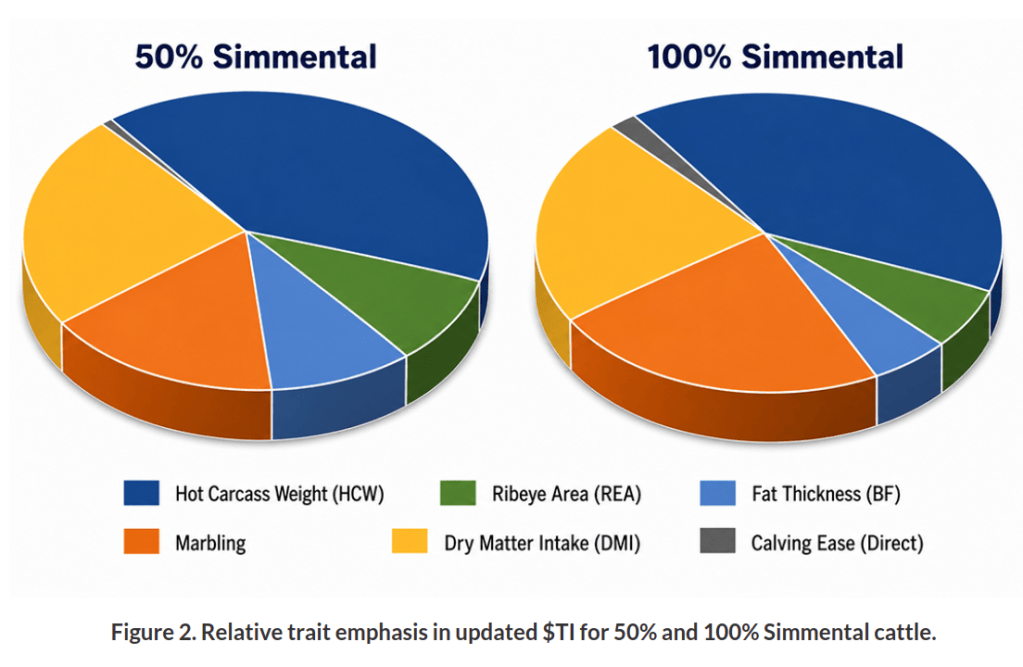
The updated indexes evaluate Simmental breed percentage in 10% increments rather than applying the same relative trait emphasis to every animal. Why does this matter? A 1/2 Simmental and a PB Simmental bull bred to Angus cows don’t contribute exactly the same expected amount of heterosis and breed complementarity. The new model may better account for those differences by adjusting the economic importance of individual traits based on the animal’s breed composition.
What does this mean when looking at your cattle and their indexes?
Expect $API and $TI values and potentially rankings to change when the updated indexes are implemented. That doesn’t mean an animal’s genetics have changed (they haven’t), however, the economic model and assumptions used to assign a value to them have changed. The indexes are becoming more specific to the production system, current economics, and breed composition being evaluated. This is why it is vitally important to ensure your actual phenotypes are being submitted to the association in complete contemporary groups and used in the genetic evaluation. EPDs are predictions built from all of the information available: phenotypes, pedigree and relationships, genomics, progeny data, and contemporary group information. Without actual phenotypes from your herd, the evaluation has less direct information about how those genetics are actually performing within your contemporary groups (helps account for environment). The more complete the data going into the evaluation is, the more opportunity we have to accurately describe the genetic differences that ultimately feed into $API and $TI.
Remember, the index is a tool that is meant to assist producers by including multiple traits within one simple to compare profitability driver. Two bulls can arrive at a similar $API or $TI through very different combinations of traits. Use the index to identify cattle with profit potential for your production objective, then look at the individual EPD traits to better understand how they arrived there.
The figures below show how relative trait emphasis differs between half-blood and purebred Simmental cattle in $API and $TI in the updated models.
-
Unraveling Genomics – Some insight into the use of genomics testing and its application in commercial cow-calf herds

Link to the original article or read on below
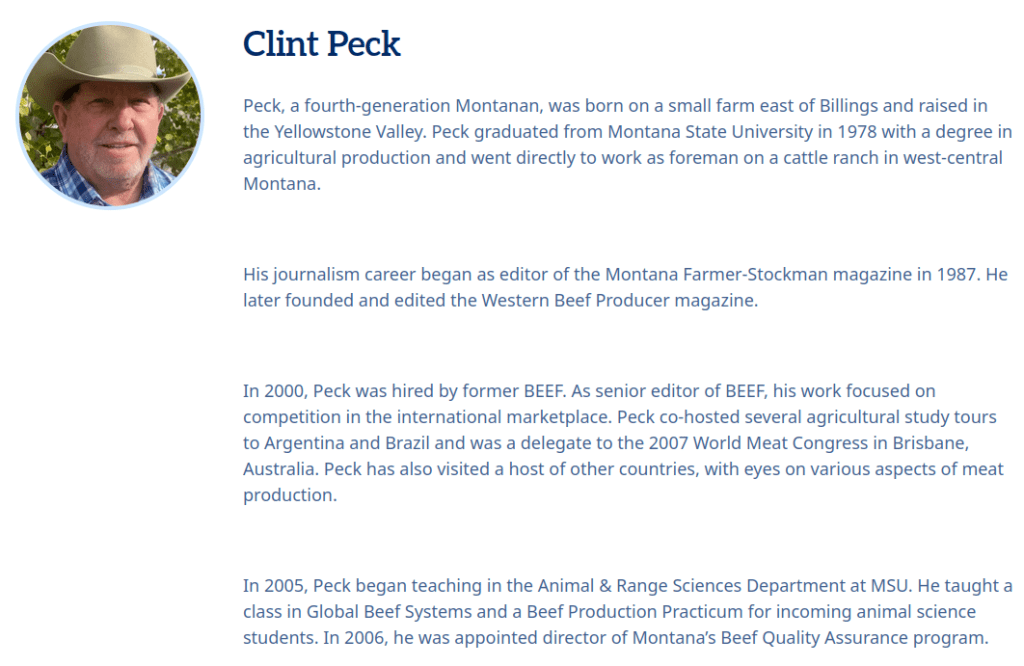
Written by Clint Peck and published by Beef Magazine April 13, 2026
Sometimes the prom queen and the prom king should’ve never had children—or sometimes it’s a match made in heaven.
That’s the mantra resonating from Leoma Donsbach when she talks about the science of genomics and beef cattle breeding. The difference in cattle is that we can peek under the exterior to examine the genetic compatibility of the prospective parents.
And to minimize “wasted matings” in their cow herd, Donsbach and her husband, Kirk, ranch near Roy, Montana. And for the past several years, the Donsbach’s have been wrapping the science of genomics around their cows in an effort to get everything they can out of the genetics they bring onto the place.
Leoma Donsbach worked for the American Simmental Association for 12 years. There, she said she found her “home” as genomics testing started becoming commercially available around 2009.
“When Simmental started down that path, I quickly saw how we were investing in the future,” Donsbach said. “That work really sparked my interest in pedigrees, and I could see that genomics was the wave of the future.”
Genomics in cattle breeding was progressing slowly at that time, though, much due to the high cost of analyzing complex and massive datasets. Genomic testing in cattle uses single nucleotide polymorphism (SNP) technology to analyze thousands of DNA markers (typically 10,000–100,000) from an animal’s tissue sample.
Any breakthrough in the technology required affordable, high-throughput SNP marker analysis for specific animal traits and accurate phenotypic recordings. That in turn required substantial computer power to generate accurate genomic-enhanced expected progeny differences (GE-EPDs) provided through breed associations.
Therefore, it’s taken some time for genomics to reach beyond the seedstock sector and show promise of paying off for commercial cattle ranchers.
“For seedstock producers, genomic testing is a no-brainer,” explained Tara Felix, PhD, beef cattle specialist with PennState Extension. “For commercial cattlemen, as genomic testing costs continue to drop, genotyping females should become increasingly popular to capture extra value.”
Herds with a superior genetic profile have a fundamental advantage over other herds, and in many cases will outperform their contemporaries over their lifetime, Felix added.
“The use of GE-EPDs on the bull side and genomic testing on the heifer side are critical,” she said. “Using good selection techniques will allow producers to choose and develop the right replacement heifers and consistently mate them to complementary sires to optimize profitability.”
And that’s the hang-up, Donsbach said—finding ways to translate the information generated by genomics testing into tangible use by cattle producers. She likens it to hiring a CPA who knows the thousands of provisions in the tax codes to help manage taxes.
That “need” led Donsbach to start her own enterprise, Data Genie LLC. in 2015. She created the company following a stint at Neogen, where she served as a strategic account manager. Today, through collaborations with partners such as Allied Genetic Resources, she continues to champion adoption of genomic tools, precision mating, and data-driven management to accelerate genetic progress and profitability.
“Genomics was coming on the scene for precision mating and we wanted to begin using the concept to help commercial cattle producers,” she explained. And Donsbach’s job is to understand genetic evaluations inside and out, regardless of the breed.
Donsbach described genomic testing as buying a pickup. “You can get the base model, then you can start adding bells and whistles, depending on what you want and what you can afford.”
She used “stayability,” or functional longevity (FL) as defined by the Angus breed, as an example of a trait that can be enhanced through genomic analysis. The FL EPD predicts the number of calves a sire’s daughter is expected to produce by six years of age compared to other sires in the population.
“If stayability is really important to you as a cow-calf producer, we can select for females that really do stay in the herd and are optimal for the environment,” she said.
Genomics analysis permits better accuracy for younger animals and allows a clear picture of several genetic traits of interest, added Felix, especially those that are expensive to measure, such as feed efficiency, carcass traits in breeding stock, reproductive traits, or maternal traits in bulls.
Genomic evaluations can also be used to avoid inbreeding depression in cattle. This reduction in phenotypic performance—such as fertility, growth, and health—results from the mating of related individuals. Donsbach said genomics has revolutionized how inbreeding depression is studied by providing more accurate measurements than traditional pedigrees.
And Zoetis Inc. recently announced the launch of bovine respiratory disease (BRD) genetic predictions in INHERIT® Select for commercial cow-calf operations. This test is an upgrade to its INHERIT Connect test for seedstock.
“This is a breakthrough for the beef industry,” said Brett Bristol, head of Zoetis Precision Animal Health. “For the first time, producers can make selection and breeding decisions based on GEPDs for BRD health and survival in addition to production traits.”
Bristol said that long term these types of innovations are expected to have meaningful economic impacts on commercial cow-calf producers and downstream to backgrounders and feeders.
Penn State’s Felix advised producers to keep in mind that with all these benefits, genomically enhancing the EPDs does not change how the EPD can be used; it just increases its accuracy.
“When a producer buys a young bull that has GE-EPDs, he’s buying with the same level of confidence in that animal as one that has already sired between 10 and 36 calves, depending on the trait,” Felix said. “In this way, GE-EPDs increase accuracy in those animals much earlier in their lives.”
Going back to her “prom king/prom queen” scenario, Donsbach points to the basics—sometimes there are things going on underneath the hide in gene combinations that, with genomics producers, have the ability to evaluate and from which to make more informed mating decisions.
“If you’re someone who’s keeping replacements, we can rank them in order of maternal genomic merit,” she said. “Genomics can help you with heifer selection— help to produce those heifers of your dreams with more consistency.”
And it can help on the sire side by choosing bulls that are truly complementary to a herd’s females while avoiding those “wasted matings”—and avoid that sick feeling when a buyer eyeballs a set of calves and asks, “Where did those calves come from?”
Donsbach recognizes that there are still ranchers who say EPDs don’t work, and she respects their opinion.
“But I would say that EPD’s overall have done what they were intended to do, which is give us more insight into the average predicted value of that animal’s offspring,” she said. “And genomics takes us a step further—a big step further.”
-
Data Genie offers genomic insights to cattle producers

By MORGAN KUNTZ-GARRISON
Dec 24, 2025Read the original article published by Farm & Ranch Guide here
With a deep background in cattle DNA testing and genomics, Leoma Donsbach started Data Genie in 2015 with the goal of building a company that could help seedstock producers navigate the often-confusing maze to get their cattle registered.“I had a dream there could be a business that could serve cattlemen in addition to helping breed associations get the data they need in the form they need to drive their evaluations forward,” Donsbach said while explaining her reason for starting the company.
In the early days of the company, Donsbach said she truly acted as a mediator between producers and the breed association they affiliated with, more often than not receiving handwritten barn notes from a too-busy rancher. She would shift through the data in the notes, organize it in the way the breed association requested, and offer insight and education to the producer when helpful.
What started as a side gig, morphed into a full-time business in 2022, and since then, Data Genie has grown and evolved into a company that now serves 90 clients across 25 different states that are affiliated with seven different breed associations. Presently, Data Genie offers services for both seedstock and commercial producers. The company’s mission is straight-forward and cutting edge – they wish to empower cattle producers to make confident, data-driven breeding decisions by transforming raw records into clear insights.
Data Genie’s seedstock services look much the same as they did 10 years ago when the company started. Registered clients employ Data Genie to help with all aspects of breed reporting, evaluation, and data collection.
“Our job is to make sure all of the T’s are crossed and the I’s are dotted so that the animals being put out into the marketplace are fully representative on paper, as well as in person,” Donsbach explained.
For commercial producers, data – especially genomic data – has not traditionally been a part of the industry, but Data Genie has found a way to offer individual and herd genomic insights on non-registered cattle.
For commercial producers, genomic data can be attained via an ear punch tissue sample. Data Genie partners with Allied Genetics and industry-leading bovine geneticists to access tissue samples and provide raw data on the individual animal. With the data, producers come to learn about their cows at their core genomic level and from there are better able to build intentional breeding matches that will mitigate risk and capitalize on their herd’s full genetic potential.
Donsbach tries to drive home with her customers that the cattle industry is evolving, and she is sincere and respectful when she says, “This isn’t your grandfather’s ranch anymore.” Modern day producers have access to much more data and breed performance metrics, and the key to being successful in cattle ranching, Donsbach argues, is mindfully balancing the traditional physical evaluation of cattle with cutting edge genomic testing.
“It’s the art of combining what we see with what’s going on underneath the hide,” she articulated.
There is no “short term” in the cattle business, so any breeding decisions that are made right now have the potential to impact your herd decades into the future. By offering cow herd genomic evaluations and with the possibility of running that genomic information comparatively against potential bull prospect, Data Genie provides cattle producers with the information they need to purchase bulls with confidence knowing they can achieve targeted breeding objectives.
“What we are doing is helping producers make desirable matings that lead to desirable calves,” Donsbach added.
The genetic information available to producers through Data Genie and their geneticist partners is really a “treasure trove.” Commercial producers can learn what cows have stronger maternal traits and therefore are more likely to raise ideal replacement heifers versus what cattle have stronger genetic potential for terminal traits. Understanding your herd at a deeper level, Donsbach says, can help producers raise a more uniform calf crop and tap into unrealized profitability within their herd.
“If we can help elevate the bottom 25 percent of your herd, what is that worth to you as a producer?” she asked.
Continuing, Donsbach said if a producer starts to home in on genomic evaluations within their herd, they can start to see real, measurable results in as little as three years. In a long-range business like cattle ranching, it is as close to an “overnight” change as you can realistically get.
It all boils down to efficiency. You can’t change what you can’t measure, and ultimately, data is power. Data Genie works to put power in the hands of the producer so they can confidently buy bulls and retain heifers knowing they will produce a calf crop that will excel in their environment and not leave genetic potential on the table.
“It’s important to keep our eye on the horizon and ensure that the investments we’re making in our bull battery are the best we can possibly make, especially since the bulls we turned out in 2025 will still be directly impacting our herd in 2042 if those daughters stay in production for 10 years,” Donsbach stated.
Data Genie offers a portfolio of different genomic testing options and reporting services for both commercial and seedstock producers. Donsbach encourages interested producers to reach out to her personally to discuss Data Genie’s services and to see what services will best fit their operation. Leoma Donsbach can be reached via e-mail at cattledatagenie@gmail.com or by calling (559)-696-4941. Data Genie is present across all social media platforms or by visiting datageniellc.com.

